

24*7 access anytime anywhere









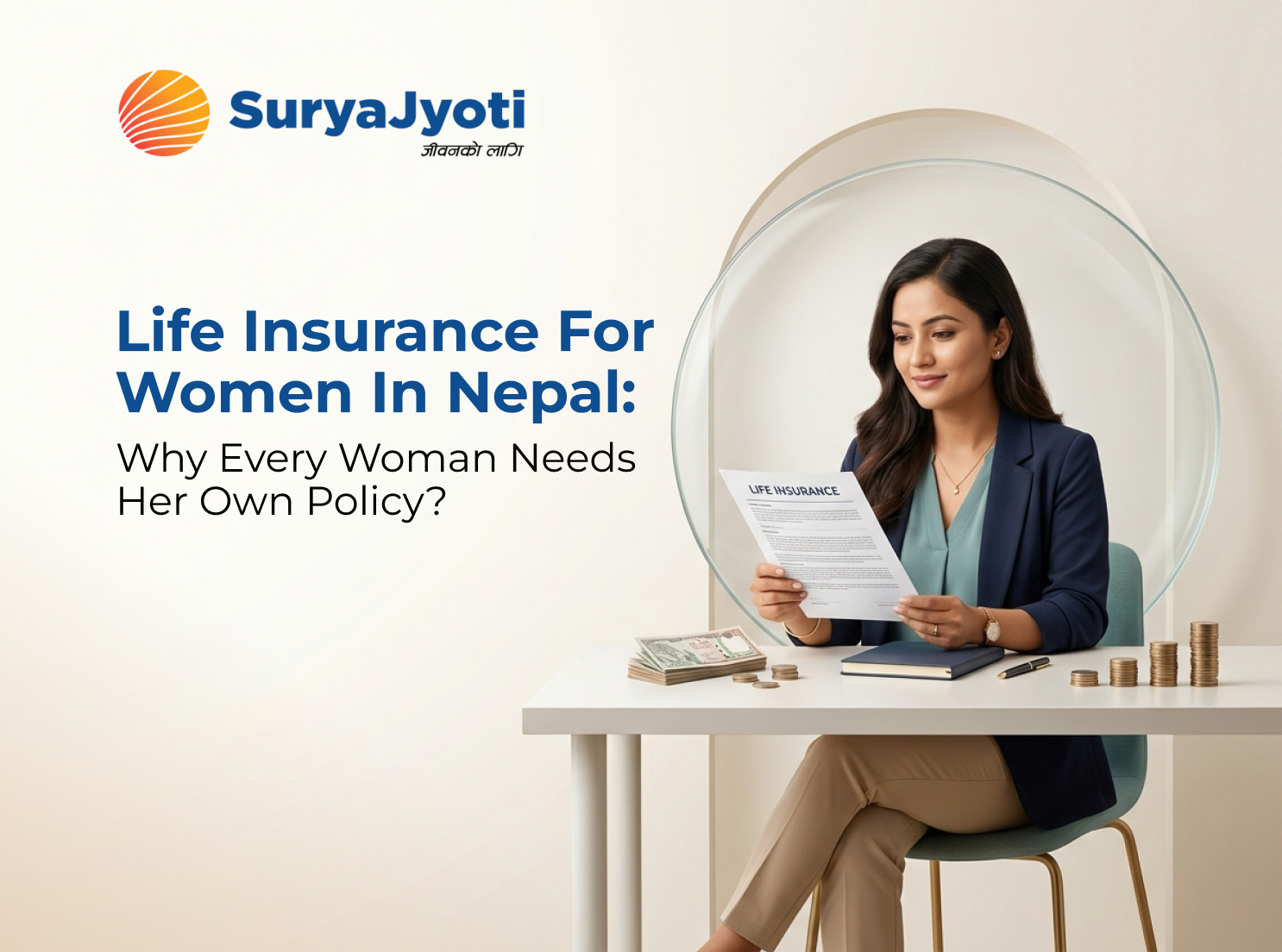
Ask a Nepali household who holds the life insurance policy, and the answer is almost always the same.
It's mostly for the husband, the father, or the son. Rarely the woman, even when she's running the family budget, raising the children, doing the farming, or has a full-time job in Kathmandu.
This gap is beginning to narrow, and for good reasons. A woman's financial contribution, paid or unpaid, deserves protection through her own policy, not one taken out in someone else's name.
In this article, we will explore the importance of having a life insurance plan and the types of life insurance suitable for women in Nepal.
We will discuss why women in Nepal should consider a life insurance plan, what it covers, and which plans are relevant to women's lifestyles in Nepal.
- A woman's financial contribution, paid or unpaid, deserves protection through her own life insurance policy, not a policy taken out in someone else's name.
- Homemakers, working women, entrepreneurs, and women whose husbands work abroad all face financial gaps that insurance is designed to close.
- Life insurance premiums in Nepal reduce taxable income by up to Rs. 40,000 a year under the current Income Tax Act, on top of the life cover and savings benefit.
- SuryaJyoti offers term, endowment, money back, and child plans suited to different life stages, along with digital tools that make buying and managing a policy simple.
Traditionally, women in Nepal have been given gold at marriage, and it has served as their default financial cushion for emergencies.
While it serves a purpose, it doesn't provide a lump sum if anything happens to you, doesn't fund your children's education, and doesn't include any guaranteed maturities or bonus payouts.
A mindset problem exists too.
Many families still see life insurance as something the breadwinner needs, and that role is usually assigned to men on paper, even in households where women contribute just as much through income, savings, or unpaid domestic and caregiving work.
A lot of times, when something occurs to the female (death, disability, or a very serious illness), the family often has no financial cushion tied to her directly.
However, this is changing as more women enter the formal sector, own small businesses, and have direct control over household finances in Nepal. The next step is making sure the insurance conversation includes them too.

A woman who manages the household, cooks, and cares for children and elderly parents is doing work with real economic value.
The family will be liable for childcare or housework expenses if she is not present. These can quickly add up to a significant amount. Her own policy accounts for that value directly.
For salaried women, freelancers, teachers, nurses, and business owners across Nepal, income replacement matters just as much as it does for male earners.
She shouldn't have to rely entirely on another person's policy for her family to keep afloat.
Women can find themselves responsible for the home when there is a divorce, separation, or when their spouse dies.
A policy in her own name does not depend on another person's decisions or on disputes over an existing family policy.
Thousands of Nepali families are now relying on remittances sent by husbands or sons who work in the Gulf countries, Malaysia, or elsewhere, leaving the women to run the household and its finances alone for years on end.
If something happens to her, the family loses its on the ground financial manager, not just an income source.
The number of women entrepreneurs in Nepal is increasing, especially in small businesses like beggars' shops and large-scale businesses.
When the owner dies or is seriously ill, the business, loans, and employees are impacted.
The value of life insurance is to pay off the debt and allow family time to determine the next steps.
The benefits of insurance go well beyond the payout after death. A well chosen policy works quietly in the background for years:
Financial security for family members. If the policyholder dies while the policy is in force, the policy benefit plus any bonuses would be paid out to the child, parent or spouse.
The discipline to save over the long term. Endowment and money back plans build a guaranteed maturity value over time, functioning as structured, forced savings that gold and informal savings groups cannot match.
Tax incentives every year. Premiums reduce taxable income annually, adding up meaningfully over a policy term of fifteen or twenty years.
No selling off assets for access to loans. Policyholders can borrow against their policy through the digital eKarja loan against policy facility, useful for medical costs or a sudden family need, without touching land or gold.
Critical illness coverage. A Critical Illness Rider pays a lump sum on diagnosis of conditions like cancer, kidney failure, or a major heart condition, money that arrives while you are still alive and need it most for treatment.
Important: A policy in your own name means you decide the nominee, the amount assured, and the policy payout. That control is important for women who want the ability to make financial choices in their own name, and not someone else's.

SuryaJyoti Life Insurance has a diverse portfolio of plans, most of which align with the financial priorities commonly held by Nepali women.
The SuryaJyoti Sahi Plan is suitable for working women who desire maximum protection at a low cost, without paying a large annual premium.
If you are deciding between pure protection and a savings linked plan, this comparison of term life insurance versus endowment plans breaks it down in plain terms.
SuryaJyoti Sawadhik Jeevan Beema and SuryaJyoti Samunnati Jeevan Beema combine protection and investment, creating a guaranteed maturity fund along with life cover, which is beneficial for women who save for a home, business, or retirement.
For mothers, SuryaJyoti Naulo Baal Jeevan Beema is a child plan that keeps supporting a child's education even if the parent is no longer around, including a waiver of future premiums and a monthly income benefit for the child.
SuryaJyoti Dhan Laav Jeevan Beema pays portions of the sum assured at fixed intervals, giving access to funds along the way rather than only at maturity.
SuryaJyoti Baideshik Rojgar Myadi Jeevan Beema is developed with the consideration of vulnerability in remittance-dependent families, specifically the risk of foreign employment, which is one of the more common vulnerabilities they face.
SuryaJyoti Surakshit Bhawishya Jeevan Beema is a whole-life insurance plan with endowment benefits, providing long-term security.
For a broader insight into saving-centric plans and policies, see this roundup of the best endowment insurance plans and policies in Nepal.
There is no single number that fits everyone.
A good first step is to project total household needs over the next few years, along with the future financial plans of their children, and then add this amount to the outstanding debt and take off the existing savings.
What remains is roughly the gap your policy should cover.
Avoid guesstimating the premium before investing. Use the Insurance Premium Calculator on the SuryaJyoti website to see the premium for different sum assured amounts and policy durations.
Under Nepal's Income Tax Act, resident individuals can deduct the actual life insurance premium paid or Rs. 40,000 a year, whichever is lower, from their gross taxable income.
For women who file taxes independently or are part of a dual income household, this is a simple, legal method to save money on the tax bill each year that the policy is in effect.
This guide to the tax benefits of life insurance in Nepal is more detailed, including calculations and guidance on how to claim the deduction.
In addition to the tax deduction, participating plans earn annual bonus additions.
SuryaJyoti's bonus rate features meaningfully to the final sum assured received at maturity or death, meaning the total received is usually greater than just the base sum assured.
In December 2022, Surya Life Insurance and Jyoti Life Insurance were merged to create SuryaJyoti Life Insurance, the first-ever merger between life insurance companies in Nepal.
That scale now translates into more than 37 lakh issued policies, over 1 lakh agents, and 176 network points nationwide, with a track record of consistent dividend and bonus declarations.
The success story of SuryaJyoti Insurance Company as a reliable choice for life insurance in Nepal is explored in greater depth here.
Repeatedly visiting a branch is no longer required either when buying or managing a policy.
You can apply for a policy online, premiums can be paid via eSewa, Khalti, FonePay, or ConnectIPS, and everything can be tracked in the SuryaJyoti mobile app.
Policyholders also get access to SuryaJyoti Cares, a program offering healthcare related benefits through the life of the policy, not just at claim time.
If you prefer a face-to-face conversation, the network points page can help you find the closest branch.
Much of the hesitation stems from misinformation rather than a lack of real need.
Some assume insurance is only for men who earn a salary, or that it is too expensive, or that claims are hard to get approved.
That doesn't hold when one checks how policies work today.
This breakdown of common myths about life insurance in Nepal addresses these directly, and if you are new to the topic, life insurance for beginners in Nepal is a good starting point.
It also helps to see the other side of the decision in this look at what happens if you don't have life insurance in Nepal.
Life insurance for women in Nepal is not about following a trend or ticking a box. It reflects a simple financial reality.
Women earn, save, run households, and support families in ways that carry real economic weight, and that weight deserves its own protection rather than depending entirely on someone else's policy.
Whether you are a salaried professional in Kathmandu, a homemaker managing the household, or a small business owner, there is a plan structured for your situation, with tax savings, guaranteed benefits, and long-term security built in.
The best time to start is while you are young and premiums are lower, not after a health scare or a financial shock makes the decision for you.
Explore SuryaJyoti's full range of insurance products, run your numbers on the premium calculator, and take the first step toward a policy that is truly your own.
Ready to secure your future on your own terms? Apply for your SuryaJyoti policy online today.
Yes, homemakers can be insured, with the sum assured typically based on the family's financial profile rather than a personal payslip.
No, an adult woman can apply for and own a policy independently, choosing her own nominee and sum assured.
No, the process is the same for everyone. This step by step guide to claiming life insurance in Nepal explains the documents and steps involved.
There is no such thing as one form of insurance being better than the other; term life insurance works well where cost and short-term coverage are needed, whereas whole life insurance works best for permanent coverage.
Yes, policy such as SuryaJyoti ekarja allows eligible policyholders to receive policy loan disbursements effortlessly via the Khalti Payment.



 Services




 Transparency Dashboard